Sunday, March 24, 2013

Angkor Thom: The Great City of
the Khmer Empire with Bayon and Ta Phrom
(2. Chapter)

Angkor Thom means "The Great City". It was established in the late twelfth century by king Jayavarman VII and the last and most enduring capital city of the Khmer empire. The earlier city Yasodharapura was centred further northwest. Angkor Thom overlapped parts of it. So the former state temple of Baphuon got part of Angkor Thom. The roads lead to the temple of Bayon in the centre.


Prasat Bayon

Picture by emilio labrador

Prasat Bayon was built in the late 12th century or early 13th century as the official state temple of the Buddhist King Jayavarman VII (1181-1218). After his death it was modified and augmented by later Hindu and Buddhist kings. Bayon is famous for the 216 serene and massive stone faces on the many towers which cluster around its central peak, symbolizing Mount Meru. On the outer wall of the outer gallery you see a series of bas-reliefs depicting historical events and scenes from the everyday life of the Khmer. The outer gallery encloses a courtyard with two libraries. The inner gallery is raised above ground level. Its bas-reliefs show scenes from Hindu mythology. You discover Siva, Vishnu, and Brahma, the members of the trimurti or threefold godhead of Hinduism, Apsaras or celestial dancers, Ravana and Garuda. The upper terrace is home to the famous face towers.

Picture by MRisgaard

Picture by marhas
You walk towards the centre of Angkor Thom and can already recognise the famous stone faces at the many towers of Prasat Bayon

Picture by marhas
On the way to the upper terrace

Picture by Anandajoti
Apsaras carved out of the sandstone

Picture by marhas

On the outer wall of the outer gallery you find a series of bas-reliefs depicting historical events and scenes from the everyday life of the Angkorian Khmer.

Picture by sharon.schneider

Picture by Peter Broer
Bas-reliefs on the outer wall of the 3rd enclosure, here showing a naval battle on the Tonle Sap between Khmer and Cham forces (in the eastern part of the southern gallery).

Have a look at panoramas of the bas-reliefs on the south wall:
Offerings, Pig-Boiling, Archers, Khmer-Cham Fighting (Archers, Spear and Sword Fights)
Three Boats with Cham, Chinese and Khmer Warriors
Hand-to-Hand Fighting, Pig and Cock Fighting, Chinese Junk
Elephants and Warriors marching to War
Palace Scene, Worshipping of 4-Armed Vishnu, Siva in a Temple, Dancing Scenes

Have a look at panoramas of the bas-reliefs on the east wall:
Elephants and Warriors marching to War (East to West)
Elephants and Warriors marching to War (West to East)
Elephants and Warriors marching to War with Intermittent Fighting (East to West)
Elephants and Warriors meet in Battle

Have a look at panoramas of the bas-reliefs on the north wall:
The Chams defeating the Khmer


Moving on in Prasat Bayon you will encounter a lot of female energy: Everywhere you see devatas.

Picture by marhas

Picture by Toby Simkin

Robert McCarthy is now cataloging the 377 devatas at the Bayon. Peter Sharrock from the School of Oriental and African Studies, estimates that the original Bayon structure displayed 6,250 celestial dancers. Read his chapter “The mystery of the face towers" in the book Bayon: New Perspectives. This book brings together leading experts and their findings and insights about Bayon's art, architecture and inscriptions. Sharrock has new answers to one of the big questions about Bayon: Who are the guys on the face towers? Many experts have said that they depict the Mahayana deity Lokesvara. But Sharrock has a different idea. He sees Tantric influence. Tantrism flourished in northern India in the Middle Ages. Sharrock thinks that the face towers depict a tantric deity called Vajrasattva. Read more on World Cultures From New Perspectives.

Picture by Peter Broer
The central sanctuary of Prasat Bayon

Picture by marhas

And now have a look at the mysterious faces:

Picture by marhas

Picture by nac888

Picture by marhas

Picture by marhas

Picture by sharon.schneider

Picture by marhas

Picture by marhas

Picture by sharon-schneider

Picture by Anandajoti

Picture by foonie


Terrace of the Elephants

The 350 meters long Terrace of the Elephants was used by king Jayavarman VII as a platform from which to view public ceremonies and it was the base for his audience hall. It was attached to the palace of Phimeanakas, of which only a few ruins remain. The middle section of the wall is decorated with life size garuda and lions; towards either end you see elephants with their Khmer mahouts.

Picture by Alan Bennett

Picture by foonie

Picture by Norman Li

Picture by marhas
From the Terrace of the Elephants you see some of the twelve towers of Prasat Suor Prat. According to a Cambodian legend, the towers served as anchoring places for ropes which stretched from one to another for acrobats performing at festivals. See also this gallery of photos.


Ta Phrom

See Pictures

Picture by foonie

Picture by ND Strupler


Banteay Kdei

See Pictures


Banteay Srei

A 10th century temple dedicated to the Hindu god Shiva. It lies near the hill of Phnom Dei, 25 km north-east of Angkor Thom. Banteay Srei is built largely of red sandstone.

Picture by ASR Photos


Bakong

See Pictures


Beng Melea

Around 40 km east of Angkor. "Did you know that Angkor Wat has a stepsister? Born to the same father, King Suryavarman II, little is known about her", notes livingif.com. Beng Melea (means Lotus Pond) has not been restored until now. So one can see the original carvings and "the strength of the jungle pulling the temple down". It was built as a Hindu temple, but some carvings depict buddhist motifs. The primary material is sandstone. It is assumed that Beng Melea was built in the early 12th century.Read more in a great essay by Willard Van De Bogart: Stones in the Sky - Part V. See Pictures

Picture by Many Moon Honeymoon

Picture by Tomomi Sasaki
The jungle takes over.

Picture by Peter Waterman

Picture by Peter Waterman


Koh Ker

The Khmer empires capital was located in the Angkor area for 500 years. But there was one short interruption: In 928 A.D king Jayavarman IV created a rival capital in Koh Ker - 150 kilometers from todays Siem Reap. One way takes 2.5 hours. The empire was ruled from here for 23 years until his son Hashavarman II returned it to the Angkor area. The most impressive ruin is Prasat Thom (Big Temple), a 7tiere pyramid.


Picture by Arian Zwegers
Prasat Thom

Picture by duhangst

Picture by mrcharly


Baksei Chamkrong

On the left side of the way from Angkor Wat to Angkor Thom. Pictures


East Mebon

The temple stood on an artificial island at the center of the now dry East Baray reservoir.


Pre Rup

South of the East Baray. Pre Rup is aligned on a north-south axis with East Mebon.
Pictures by foonie.


Preah Khan

Northeast of Angkor Thom. See pictures by foonie.

Picture by ggallezot


Ta Keo

A causeway of 500 meters connects its eastern entrance to a landing stage on the Eastern Baray. Pictures by foonie


Ta Som

Northeast of Angkor Thom. See pictures by foonie.

Picture by foonie


Read what National Museum of Cambodia writes about
Khmer Art History
See also the National Geographic Documentary:
Stolen Treasures of Cambodia 1
Stolen Treasures of Cambodia 2
Stolen Treasures of Cambodia 3

Cambodia is trying to get back stolen art, for example from the Metropolitan Museum of Art in New York. The so-called Kneeling Attendants are the highlight of its Southeast Asian collection. They originally adorned the sanctuary of Prasat Chen, at the temple complex of Koh Ker. Paramilitary groups trafficked them, sculpture by sculpture, overseas. Read:
Should Cambodian 'blood antiquities' be returned? on http://edition.cnn.com
Cambodia Says It Seeks Return Of Met Statues on nytimes.com
A legal battle in the US over the fate of a 10th-century Khmer statue has heated up, with federal prosecutors accusing the international auction house Sotheby’s of lying about its provenance in an effort to sell it for millions of dollars. They claim that both Sotheby’s and the statue’s owner knew the statue had been stolen from the Koh Ker temple complex in the early 1970s. Read on phnompenhpost.com.


Far from the madding crowd of Angkor Wat, in a remote southern province in the Mekong floodplain, Lawrence Osborne wades deep into Cambodia’s misty past—and the source of some of the country’s most magnificent and mysterious art. Read:
Cambodia's Undiscovered Temples on cntraveler.com about Phnom Da, Angkor Borei and Phnom Bayong.


Read more:

Angkor Archaeological Park: The incredible remains of the Khmer empire (1. chapter)

Siem Reap - the gate to Angkor

Hotels and Guesthouses in Siem Reap – and your reviews

Mouthwatering food in Siem Reap: Reviews of restaurants.

Magical Tonle Sap Lake: Living on the water and with the nature

Siem Reap - the gate to Angkor

See the locations on Siem Reap and Angkor Wat Google Map
See also Siem Reap Map

Picture by pmorgan
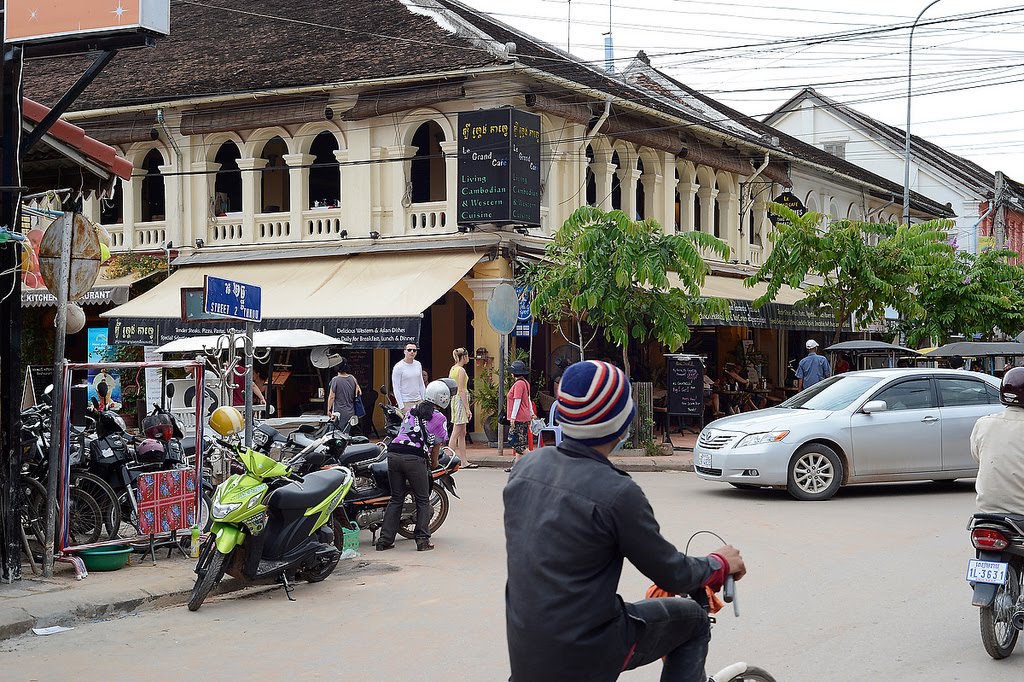
Le Grand Café


Picture by LightOnDude

Picture by Ramon Stoppelenburg
The Blue Pumpkin

Picture by flying_tiger
Siem Reap with the old market (Psar Chas) on the left

Picture by spotter_nl
Inside Psar Chas

Picture by Johan Douma

"A chic haven of rest an relaxation": Naomi Lindt is full of admiration in 36 Hours in Siem Reap, published by nytimes.com. The Town has developped from a cluster of small villages along the Siem Reap River, which meets the Tonle Sap Lake in the South. Along the river you find Buddhist Pagodas (Wats) as centres of the villages, from Wat Preah En Kau Sei in the North to Wat Phnom Krom in the South.

Picture by ggallezot
Pi Thnou Sreet


Picture by matthewhooper
Pub Street by day and...

Picture by bluelizardworld
... Pub Street in the night.


The main town with old colonial and chinese style architecture is concentrated around Sivutha Street and the Psar Chas (Old Market) area.

Picture by Laura Longenecker
Seafood at Psar Chas

Picture by Jonas Hansel
Central Market

The Wat Bo area is full of guesthouses and restaurants while the Psar Leu area is crowded with jewellery and handicraft shops. The word Phsar means Market, Leu means Upper. It is located about 2 km from Siem Reap, on the right side of National Road 6 when travelling from west to east.

Picture by Ed-meister
Phsar Leu Market


You should not miss the traditional Apsara dance performances. Many hotels show them, but there is also the Apsara Theatre, an elegant wooden performance hall. Read more about The best dance performances in Siem Reap.

Picture by dalbera
Dancer of the Apsara ballet in l'Amazon Angkor Restaurant.


Angkor National Museum

Picture by e_chaya

Opened on 12 November 2007 the Angkor National Museum presents the Golden era of the Khmer Kingdom in eight eight galleries:
Exclusive gallery: 1,000 Buddha images
Gallery A: Pre-Angkor Period: Khmer Civilization
Gallery B: Religion and Beliefs
Gallery C: The great Khmer Kings
Gallery D: Angkor Wat
Gallery E: Angkor Thom
Gallery F: Story from Stones
Gallery G: Ancient Costume


Discover the treasures of Angkor Wat and Angkor Thom: Angkor Archeological Park


Arts in Siem Reap

Art Deli: Housed in a 1920’s French colonial building in the Alley West, the ArtDeli is a gallery, library, café-bar, and an alternative performance venue. It serves Italian cuisine and organic meals by Trattoria Pizzeria and the Singing Tree Café next door.

McDermott Gallery: Two exhibitions, one in FCC Complex at Pokambor Avenue, the other one lies in the passage between Pub Street and the Old Market. In FCC John McDermott shows his own work, pictures of the temples of Angkor, that "are not just beautiful but iconic. Dreamlike photos, which look as though they were taken in an ancient, forgotten world", wrote the New York Times.

Red Callery: FCC-Complex. The British Artist, Teacher and Art Project Coordinator Sasha Constable, living in Cambodia since 2000 shows here her own work.

Theam's House: No.25, Phum Veal. Located on the main road to Angkor Temple, Atelier and Art Studio. For more than 10 years artistic director of Artisans d’Angkor, now Lim Muy Theam has launched a new project that includes training a team of artisans apprentices. And he continues with his own painting. In the gallery you discover paintings, ceramics, wood carvings, and more. Read the reviews on tripadvisor.com and the article Lacquered elephants and bald Buddhas rule at Theam’s House by Miranda Glasser on phnomphenhpost.com. Open daily from 8am to 7pm.

Picture by Theam's House

Picture by Theam's House

The Arts Lounge: Hotel de la Paix. "Exhibitions with an emphasis on Cambodian artists and international artists with a strong connection to Cambodia", notes travelfish.org. And a bar with DJs.

1961: Osaphear Street. An art center comprising of a series of galleries, boutiques, food & dining outlets and an 8-room hotel.


Shopping in Siem Reap

Read Cambodia’s temples of consumerism on ft.com. After that you will be eager for a shopping tour in Siem Reap. Consult Shopping the Gorgeous Stores of Siem Reap – An Itinerary

Artisans d'Angkor: Artisans Angkor is a company which was originally created to help young rural people find work near their home village. Since its creation at the end of 1990s, Artisans Angkor has strived to offer good working conditions and social advantages to its employees. It has now opened 42 workshops in Siem Reap province and it provides employment to over 1300 people, including more than 900 artisans. The company offers silk fabrics and garments, stone and wood carving, lacquer ware, polychrome products, silver plating and silk painting.
Eric Raisina Villa Boutique Workshop: Heard of Eric Raisina? Yves Saint Laurent, Christian Lacroix, Jean Paul Gaultier and Issey Miyake are some of the fashion brands that get fabrics from him. "No words can describe the things that this Madagascar-born and - since 2002 - Siem Reap-based designer can do with silk", notes anothertravelguide.com. "Although things designed by Eric Raisina can be obtained in the Heritage Hotel and Amansara shops, a visit to his own showroom in Siem Reap is a must; it is located in Raisina's house, not quite in the centre of the city." See pictures of the atelier on fuchsiaboy.blogspot.com. Eric Raisina's choice of Siem Reap was not accidental. Siem Reap is only ten miles away from the Puok District, which has a tradition of silk production dating back to the 13th century. "Eric Raisina insists that his fabrics must be touched and felt. That helps to better appreciate their distinctive texture", writes Roman Poroshyn. See video Luxe dans les détails. And read an interview with Eric Raisina.

Picture by shu tu

Poetry: The Lane. Filipino fashon designer Don Protasio has been living in Siem Reap for six years, as Destination Asia tells us. He does a line under his name, but also PAID, a line from recycled fabrics. See him posing in Siem Reap. Follow his blog Fuchsiaboy. He startet the shop Petry with Hotel 1961 owner Loven Ramos.

Picture by Poetry

Garden of Desire: The jewellery store of Cambodian Pisith Ly, who makes jewellery from precious gems, quality metals and natural materials, like stone and wood. Pisith fled Cambodia as a young child after the Khmer Rouge murdered his family and moved to Paris, where he studied fine arts and designed for Alain Mikli and Phillipe Starck. He returned to Siem Reap. Read his story on Phnom Penh Post.

Picture by Garden of Desire

Wanderlust: Alley West. Wanderlust, a boutique founded by Elizabeth Kiester, the founder and former chief creative director of LeSportsac. who came to Cambodia in 2008 and decided to stay. But she has left the company two years ago.


Scams with gems: Be careful with shopping gems in Siem Reap. There are a lot of stories about scams. For example babygirl0 was not pleased with the service of City Gems, her comment on fodors.com.

Find an overview of shops in Siem Reap.


Cambodian Cultural Village

Cambodian Cultural Village is “Cambodia in miniature” in Siem Reap shows the rich natural and cultural heritage of the Khmer people. Inside you find representations of Cambodia’s 11 Villages, houses of different architectural styles. At each village there are traditional dance performances, traditional wedding ceremonies, performance of ethnic minorities, Apsara Dancing, Circus, Acrobatic, popular games and the Grand Khmer Family white Night Shows. Wax museum exhibits the development of Cambodian Culture from the first century up to present. See show performaces.

Picture by narin-flickr


Temples in the city

Wat Bo: One of the oldest Buddhist monasteries in Siem Reap. Built in the 18th century, the pagoda has an epic Khmer poem painted on its wall, based on India’s Ramayana called Reamker (see pictures). According to Andy Brouwer they date from 1920-1924 and were executed by two shadow puppet designers, Ta Peul and Kong Dith, though some claim it may've been earlier. You can also see 19th century paintings depicting Siem Reap’s daily life under the French on the interior walls of the vihear. Wat Bo is also a place, where archaeological and art objects are kept. It was monk Pin Sem's desire to prevent them from export abroad. He first started to collect the treasure in 1986-87, when he had been hiding from the Khmer Rouge at the Cambodian-Thailand border, where Khmer treasures were being sold to Thailand. He bought the objects from the sellers and preserved them. Thousands of objects are housed at the monastery: statues, utensils, jewelries, musical instruments, ceramics and human skeletons, dating from prehistoric times to the present day. There is now a database called Wat Bo Earthern Ware Ceramics, created by members of the University of Sydney (read more in the book Water Civilization: From Yangtze to Khmer Civilizations. The 5oo ceramics were found at Phum Snay area of Banteay Meanchey Province in Cambodia. More background here.

Picture by marhas

Picture by rhowell74
The murals at Wat Bo show the Reamker

Picture by rhowell74

Picture by rhowell74
Wat Bo, see more pictures

Picture by ggallezot

Picture by rhowell74

Picture by don_macauley

Picture by marhas


Wat Damnak: The name Dam Nak stands for palace - here used to be the a royal palace during the reign of King Sisowath. Today you find here a temple with schools and a very nice garden as well as the the Centre for Khmer Studies with a large library..

Picture by judithbluepool


Wat Preah An Kau Sai:

Picture by Pigalle


Bach at Jayavarman VII Hospital: If there is no justice, there is no peace

Every Saturday, at 7.15 pm and sometimes also every Thursday at 7.15 pm: Swiss doctor Beat Richner he calls himself Beatocello - plays Bach on the cello and speaks about the activities of his four children's hospitals in Cambodia. And he shows a film about 20 years of work for justice in Cambodia. Justice? Yes, read more here.

Picture by krismartis
Dr. Beat Richner, playing cello


Where wild animals are protected

Picture by Angkor Centre for Conservation of Biodiversity
Sunda Marabu at ACB

The wildlife and biodiversity in Cambodia is endangered for example by illegal wildlife trade - and the Angkor Centre for Conservation of Biodiversity (ACCB) aims to protect them. It is the first nature conservation centre in Cambodia. And it rescues wild animals, breeds endangered species and works for environmental education. At the centre actually live Pileated Gibbon (Hylobates pileatus), Silvered Langur (Trachypithecus germaini), Northern Slow Loris or Bengal Loris (Nycticebus bengalensis), Malayan Pangolin (Manis javanica), Asian Palm Civet (Paradoxurus herma­phroditus), Leopard cat (Prionailurus bengalensis), a wild boar, two Malayan Porcupines and one Pig-tailed Macaque, birds, snakes and turtles. ACCB is upported bei Münster Zoo in Germany. Read more about the animals.
The ACCB is open to guided tours and located at the site of Kbal Spean, 12 km north of Banteay Srey. You find the gate next to the car park. Regular guided tours are offered Monday to Saturday at 13 pm, they last around 1 hour 30 minutes and require a minimum donation of 3 USD. During the tour you can see a variety of animals and learn first hand about efforts to save Cambodia’s wildlife. If you have a valid temple pass you can also see the waterfall and riverbed carvings at Kbal Spean. Read more about ACCB tours.


Getting to Siem Reap

Bangkok Airways offer several daily flights to/from Bangkok, Chiang Mai, Lampang and Trat. Now Cambodia national carrier Cambodia Angkor Air (CAA) officially confirmed to operate a daily flight from Siem Reap to Bangkok, starting November 30. Lao Airlines has flights to and from Luang Prabang, Pakse and Vientina. Vietnam Airlines flies to and from Hanoi and Ho Chi Minh City. Air Asia flies to and from Kuala Lumpur. Cambodia Angkor Air flies to and from Phnom Penh. Singapore Airlines to and from Singapore. Korean Air flies to and from Seoul. Myanmar Airways International flies on Wednesdays and Saturdays to Rangoon.

More ways of getting to Siem Reap on canbypublications.com. Bus-Schedules here.


More Informations about Siem Reap

siemreap.net


Read more:

Hotels and Guesthouses in Siem Reap – and your reviews

Mouthwatering food in Siem Reap: Reviews of restaurants.

Angkor Archeological Park : The incredible remains of the Khmer kingdom

Magical Tonle Sap Lake: Living on the water and with the nature