Updated June 26 2026
In China the courts know him as Hu Xiaowei 胡晓伟, born in 1982. On the Caribbean islands Saint Kitts and Nevis he was registered as Chen Xiao'er 陈晓儿. Near Holland Park in London be bought a Victorian mansion for USD 39 million with the name Wu an Ming 吴安明. In Singapore he held shares of companies with the name Hu Shi 胡适. From this name there was a connection to a a nine-unit luxury property on Stanley Beach Road in Hong Kong. Here we will call this man with multiple identities Hu, according to his Chinese family name. Hu has for some months remained at large. He was a fugitive being tracked by Chinese, Taiwanese, Singaporean, South Korean, U.S. and UK authorities.
But now Hu Xiaowei has been arrested in Osaka according to The Asahi Shimbun together with two other Chinese nationals. According to NHK investigative sources say Hu repeatedly entered Japan under a Highly Skilled Professional status with a five-year period of stay. This status was introduced in Japan in 2015 for highly skilled foreign professionals who are expected to contribute to Japan's academic research and economic development.
In Taiwan prosecutors labeled Hu Xiaowei "second in command" of the Cambodia-based Prince Group, guided by Chinese-Cambodian chairman Chen Zhi, in early 2026 arrested in Cambodia and extradited to China in January 2026 for allegedly masterminding a massive cyber-fraud empire involving forced labor compounds and multi-billion dollar cryptocurrency frauds. Some say, that Chen Zhi used to call Hu "big brother". Southeast Asia has been hit by a cyber-fraud crime wave of epic proportions over the past decade. In countries like Cambodia, Myanmar, and the Philippines, industrial-scale scam operations have targeted victims around the world, stealing as much as $64 billion annually, according to a United Nations report this year. Hu Xiaowei seems to be a mastermind in this business and in laundering the stealed fortunes. But so far he has denied to be involved in the operations of Prince Group.
In Taiwan Hu Xiaowei is accused of presiding over a network of 250 companies across 18 countries to disguise criminal proceeds. In Taiwan, he allegedly set up nine key subsidiary firms, many of which operated from the same building: Peace Palace (和平大苑) tower block in Taipei's Daan District. His St. Kitts and Nevis passport provided him visa-free or visa-on-arrival access to approximately 150 countries and territories, including the UK, EU and Hong Kong. He holds also citizenships from China, Cambodia and Cyprus. With these changing identities he was able to hide his connection with the cyberscam frauds and launder it with property investments according to the investigators.
The sanctions by U.S. Treasury and UK
The U.S. Department of the Treasury's Office of Foreign Assets Control (OFAC) sanctioned Hu in late 2025 under the name Chen Xiao’er as a key member of the "Prince Group Transnational Criminal Organization". The sanctions were paired with actions against Xinbi (or New Coin), a illicit Chinese-language crypto marketplace Hu allegedly used to move stolen assets. On March 26, 2026, the UK Foreign, Commonwealth and Development Office (FCD) sanctioned Xinbi as a critical financial layer for scam centers across Southeast Asia. The action also targeted Legend Innovation Co. and its director Eang Soklim as operator of #8 Park — described as Cambodia's largest scam compound; Thet Li, a key lieutenant of Prince Group chairman Chen Zhi, who has managed the Prince Group's international financial network, and Hu Xiaowei. These international sanctions provided the legal basis for Taiwanese authorities to seize approximately US Dollar 144.95 million in local assets, including luxury apartments in Taipei.
The UK Government sanctioned Hu for his role as a key financial enabler for the Prince Group. All UK-based funds and economic resources of Prince Group were frozend, worth estimated US Dollar 1.5 billion.
Hijacking around "Legend of Mir"
On July 24, 2011, the Chongqing Municipal Public Security Bureau's Cyber Security Division in China busted a piracy network called “Knight Attack Group”, a criminal hacking ring that hijacked private server advertising platforms around the South Korean game "Legend of Mir" with DDoS attacks, reportedly skimming over $10 million in advertising revenue from almost 200 servers across China. Founder Cai Wen had recruted Hu Xiaowei, who was born in 1982 in Suqian, Jiangsu Province, graduated from Chongqing University in 2005 and worked for a local electronics company as a marketing manager. Hu was identified as the Chongqing ringleader, but he fled abroad. Caixin reported that also Chen Zhi was a member of the group but was not among those arrested.
On November 2 in 2011 Hai Lian Engineering Investment Group Limited 海聯工程投資集團有限公司 has been registered in Hong Kong, located on Concordia Plaza, Science Museum Road, Yau Tsim Mong. For the registration the name Chen Xiao'er has been used.
2011: Chen Zhi and Hu Xiaowei flee to Cambodia
When applying for a bank account in the British Isle of Man in 2019, Chen Zhi listed an unnamed uncle as the source of a $2 million loan used to establish his first Cambodian real estate company, as compliance documentation reveales. Speculations that Hu Xiaowei could be this "uncle" have not been confirmed. Journalism and law enforcement sources show that Chen Zhi likely amassed his foundational wealth in China's internet underworld through the "Knight Attack Group", where Hu Xiaowei has been involved. Corporate and investigative records show that Chen Zhi arrived from China's Fujian province and almost immediately plunged into Cambodia's real estate sector in 2011. This happened after the Chongqing police raided and dismantled the Knight Attack Group. At the same time Hu Xiaowei dislocated his activities to Cambodia. Chinese corporate records show, that 2015 both were shareholders of Zhongjing Technology Investment Co Ltd, registered in Beijing. This company was established on December 11, 2013.
Reports indicate that Hu Xiaowei apparently returned to China and was arrested in 2016 on charges related to a massive $850 million online gambling operation. He had reopened pirate servers for “The Legend of Mir 2.” Wemade Entertainment Co., Ltd., the copyright holder of the online game "Legend of Mir," filed a report with the Yinchuan police, alleging that Chongqing Xiaoxian Online Technology Co., Ltd., controlled by Hu, had been illegally operating the game by setting up private servers for "Legend of Mir". Police officers in Yinchuan, said that Chongqing Xiaoxian amassed over 6 billion yuan in illicit funds within two years of its establishment.
Investments in Singapore
Hu Xiaowei is linked to Future Oasis Pte Ltd, a Singapore-based company incorporated in 2022 and set up as a family office, whose sole shareholder is Future King, a British Virgin Islands-registered firm ultimately owned by Hu. In June 2026 the police of Singapore declared that they are investigating Hu Xiaowei and Qiu Wei Ren over alleged money laundering offences linked to Prince Group by the company Future Oasis. Since March 2026, more than S$600 million in cash and assets, including three properties, a yacht and luxury cars, bags and watches, have been seized or placed under prohibition of disposal orders by authorities in Singapore. Qiu had served as the director of a now-defunct Singapore management consultancy firm, Fly the Sky International Management, between 2021 and 2025. The firm had $2 million in start-up capital and five directors who held citizenships from Cambodia, China, Cyprus and Malaysia.
Shell companies on British Virgin Islands, acivities in Hongkong and investments in Singapore and United Kingdom
Future King Inc. is Hu’s primary holding company on British Virgin Islands (BVI), incorporated in February 2017. He used his alias Wu An Ming in Hong Kong stock exchange filings to control this company. Through Future King Inc., Hu owns the beneficial rights to several Hong Kong-based asset management firms, especially China Reserve Securities Ltd. and Future Wing Financial Company Ltd. According to the U.S. Department of the Treasury, Future Wing Financial Company Limited received millions of dollars directly traced to cryptocurrency investment scams of Prince Group. China Reserve Securities, backed by its licensed financial status in Hong Kong, provided a veil of institutional legitimacy, allowing the network to layer and move funds through international banking channels. Future Oasis Pte Ltd was established in Singapore in 2022 as a family wealth office. Tthe network of this companies controlled by Hu Xiaowei was to channel the layered proceeds from the Hong Kong entities into Singapore to purchase high-value real estate, luxury yachts, supercars, and high-end consumer goods.
Future King Inc. owns several other shell companies registered in Hong Kong that are utilized to shuffle funds and manage physical properties: Future Cosmos Limited; Future Cosmos One Limited; Future Cosmos Two Limited; CN Crystal Limited and CN Breeze Limited. CN Breeze Limited according to OCCCRP was the registered owner of a private jet. Flight records showed the jet made multiple trips to Japan starting in March 2023, carrying key insiders of Prince Group.
More details about people and companies sanctioned by Office of Foreign Assets Control of U.S. Treasury.
The Hong Kong High Court in May 2026 has frozen HK$8.93 billion (USD 1.15 billion) in assets tied to the Prince Group's founder, Chen Zhi, and his associates—including Future King Inc. and its controller Hu Xiaowei —following an application by the Hong Kong Justice Department. Frozen are stock and crypto holdings and bank deposits, HK$400 million belonging explicitly to Hu Xiaowei. The Hong Kong High Court has scheduled a follow-up hearing for August 3 to review the injunction and determine whether the asset freeze will be extended.
Eagle Fortitude Limited is another company of Hu un British Virgin Islands, incorporated in May 2019, also sanctioned by OFAC on 23 June 2026. According to the U.S. authorities this company was utilized by Hu under his alias Chen Xiao'er to embed himself into legitimate equity markets. Hu used Eagle Fortitude Limited for takeovers and holding shares in publicly traded entities, such as Cayman-incorporated HKE Holdings Limited on the Hong Kong Stock Exchange with the intention to get legal stock market gains.
Leisure Focus Limited is another company on BVI controlled by Hu, established in July 2020. it was blocked under the June 2026 US sanctions sweep to sever Hu’s ability to move capital through Caribbean offshore havens. Leisure Focus Limited acquired the Imperial College Sports Ground at Udney Park Road in Teddington in southwest London in August 2022, where Hu operated with the alias Wu An Ming.
Investigations by the Organized Crime and Corruption Reporting Project (OCCRP) revealed that Hu Xiaowei held a U.K. property portfolio valued at least at USD 45 million. According to OCCCRP he also purchased for 30 million British pounds ($39 million) a central London mansion in his own name in 2022, which was partly financed with a mortgage from Citibank. The mansion is a stone’s throw from Holland Park, in one of the most expensive residential areas in London.
The U.K. Foreign, Commonwealth & Development Office (FCDO) has frozen Hu's properties in March 2026.
Read also:
Chen Zhi: Cyberscam Tycoon escorted to China by Beijings most prominent SWAT Team - far away from U.S. Courts
Chen Zhi - Inside one of Asia's allegedly most sophisticated Transnational Criminal Organization. What happened
Friday, June 26, 2026

Wednesday, March 25, 2026
Angkor Archaeological Park:The incredible remains of the Khmer empire (first chapter)
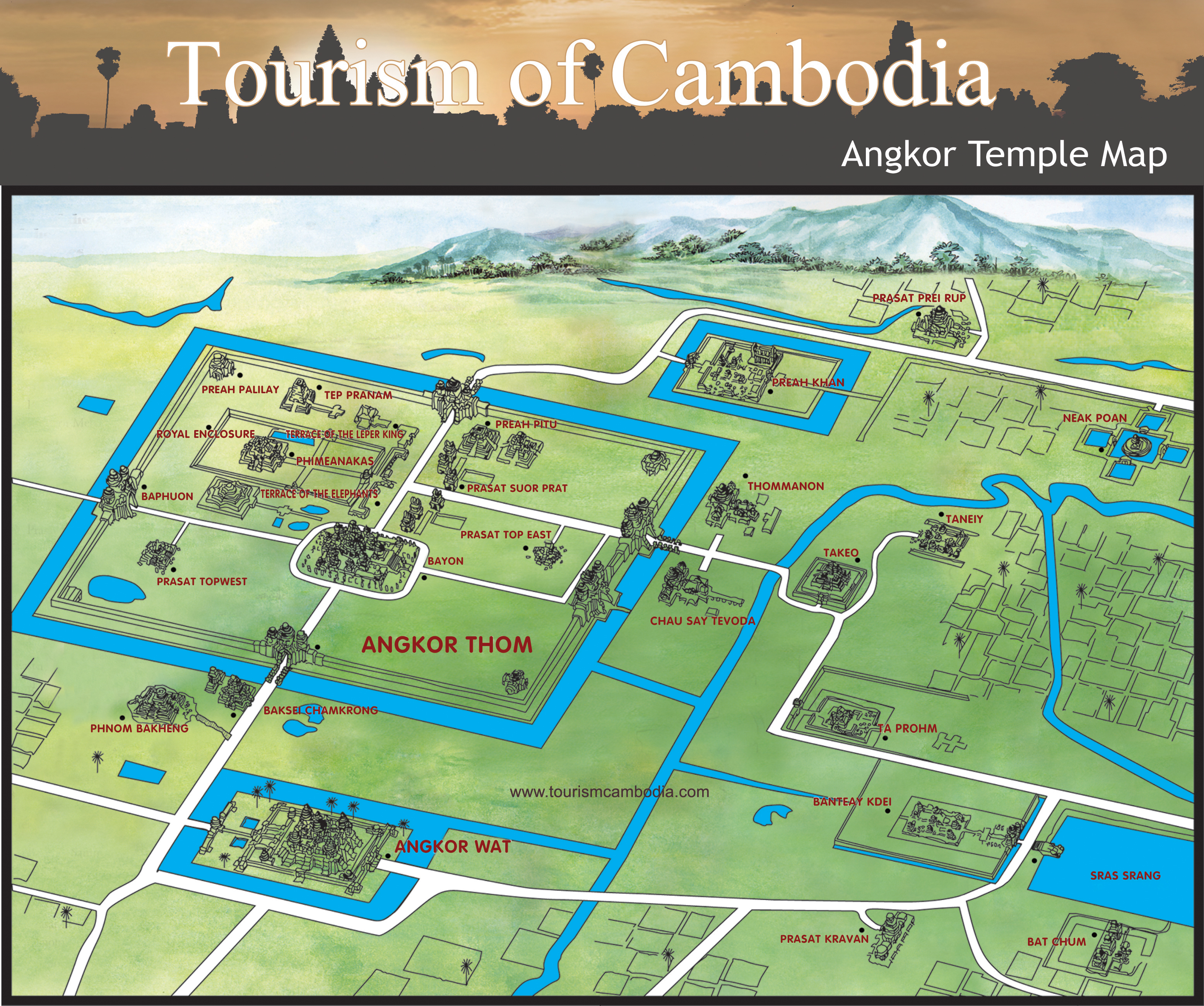
See the locations on Angkor Archaeological Park Area Map and on Angkor Archeological Park Google Map
 Picture by marhas
On the causeway towards Angkor Wat
See Photo Gallery: Angkor Wat and Angkor Thom
Stretching over incredible 400 square kilometers, including forests, Angkor Archaeological Park contains what remains of several capitals of the Khmer Empire from the 9th to the 15th centuries. These are the remains of the largest pre-industrial city in the world. The most famous buildings are the temple of Angkor Wat and, at Angkor Thom, the Bayon Temple with its countless sculptural decorations. In the 12th Century AD, the Khmer Empire ruled most of what is now Southeast Asia. King Suryavarman II built the temple of Angkor Wat at the height of his empire’s glory. But within 200 years, the powerful Khmer civilization mysteriously collapsed. And the jungle swallowed the magnificent Khmer temples and cities. Only in the 19th century French explorers rediscovered the ruins. In 1992 Angkor Archaeological Park was declared a UNESCO World Heritage site.
 Picture by marhas
Bayon temple
Prepare your discovery tour
Prepare your discovery of Angkor Archaeological Park by reading one of the best guidebooks. Download it here for free: The Monuments of the Angkor Group by Maurice Glaize has been published in 1944 in Saigon, republished in 1948 and again in Paris in 1963. A good overview of Angkor Archaeological Park you get on Wikitravel. Helpful is also the chapture about Khmer Architecture on Wikipedia. Helpful is this Map of Angkor Thom and Angkor Wat.
Angkor Wat is home to one of the world’s most fascinating archaeological mysteries: Why do images of women dominate the largest religious monument on earth? You find more than 1700 women realistically rendered in stone. devata.org is dedicated to these questions.
 Picture by marhas
Women in the inner gallery of Angkor Wat - two out of more than 1700 women carved in stone. What did these women mean to the Khmer rulers, priests and people?
See movies about Angkor:
Ancient Magastructures: Angkor Wat by National Geographic (2008)
Angkor Wat: The Eighth Wonder by Digging for The Truth
The lost world of Angkor by Discovery Channel
Walking the Royal Road: The Ancient Kingdom of Angkor. Dr. Jennifer Foley of the Virginia Museum of Fine Arts lectures on the ancient Southeast Asian kingdom of Angkor and the structures at Angkor Wat.
Axis Mundi. A film about Angkor Wat
Start your Angkor Wat tour
Angkor Wat's rising series of five towers culminates in an impressive central tower that symbolizes mythical Mount Meru, surrounded by chains of mountains (the walls) and the cosmic ocean (the moat). Mount Meru is the home of the gods in Hinduism. Thousands of meters of wall space are covered with stone carving depicting scenes from Hindu mythology. See a map with the galleries.
 Picture by Toby Simkin
On a 200 meters long and 12 meters wide sandstone-paved causeway you cross the 190 meters wide moats enclosing Angkor Wat. And you walk towards the west main gate with tower, called Gopura, which ist part of the 1025 by 802 meters external enclosure. This outer wall encloses a space of 820,000 square meters.
 Picture by marhas
The moats surrounding Angkor Wat are five and a half kilometers in their overall length.
 Picture by marhas
In the gallery inside the external enclosure you discover these stone carvings on top of a door.
 Picture by marhas
And you encounter this devata - one of the more than 1700 women portrayed in Angkor Wat
 Picture by victoriapeckham
From the semi-darkness of the western gopura you get the looming perspective of Angkor Wat and its 350 meters long causeway, framed in the door.
 Picture by marhas
Don't miss this reflection in the northern pool: The temple of Angkor Wat,raised on a surrounding terrace with sugar palms and mango trees.
 Picture by mikkelz
Finally you arrive in front of the temple. It stands on a terrace and is made of three rectangular galleries rising to a central tower, each level higher than the last. The height of Angkor Wat from the ground to the top of the central tower is 213 meters. The outer gallery measures 187 by 215 meters. And it contains the famous bas-reliefs of Angkor Wat showing epic events. If you begin on the western side and keep to your left you will see the following events: Battle of Kurukshetra, Army of Suryavarman II, Heaven & Hell, Churning of the Ocean of Milk, Vishnu Conquers the Demons, Krishna & the Demon King, Battle of the Gods & the Demons and Battle of Lanka (read more here).
Angkor Wat during the spring equinox: Every year around 21 March, when the tilt of the Earth's axis is inclined neither away from nor towards the Sun and the center of the Sun is in the same plane as the Earth's equator, you can experience the astronomical knowledge of the builders of Angkor Wat. The temple aligns to the rising sun. On the morning of the spring equinox, the sun rises up the side of the central tower and crowns its pinnacle.
 Picture by take..
Special phenomenon on March 21: The Sun crowns the pinnacle of the central tower of Angkor Wat
Of course this gives room to many spiritual intrepretations, for example you can read Stones in the Sky by Willard Van De Bogart in 2003 or see the video Heaven's Mirror by Graham Hancock. Eleanor Mannikka, of the Indiana University of Pennsylvania, argues in her work Angkor Wat: Time, Space and Kingship, that the dimensions, alignment and bas-reliefs of Angkor Wat encode a message that Suryavarman II was the divinely appointed king. Read her text The Role of Astronomy at Angkor Wat. Here she writes: "On the morning of the vernal equinox day (roughly March 21st each year), once we have passed through the main western entrances and stand facing the interior grounds of the temple, we encounter a spectacular solar alignment. At 6:35 a.m., the sun can be seen rising dead-center over the top of the central tower of the temple - about 500 m. away - when observed from the top of the first northern staircase of the western causeway. Three days later, the sun can be seen rising over the central tower for the second and last time, from the center of the western causeway at a point just a few meters south of the first observation position."
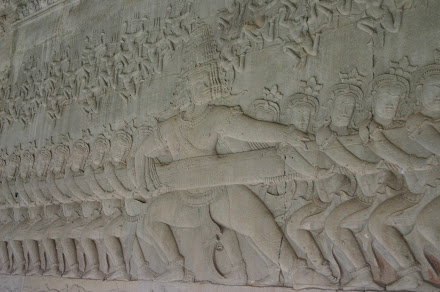
The website Treasure of the Ancient Khmer draws heavily from the book of Mannikka and has excellent maps of the temple and its galleries. She points also to the bas-relief panel at the Eastern outer gallery, which shows the Hindu creation myth Churning the Sea of Milk. In the center is the serpent Vasuki, who offered himself as a rope. The serpent was yanked back and forth in a giant tug-of-war that lasted for a thousand years. In the bas-relief panel, the front end of the serpent is being pulled by 91 asuras (demons), anchored by the 21-headed demon king Ravana; on the right are 88 almond-eyed devas (gods) pulling on the tail, anchored by monkey-god Sugriva. Mannikka says that the 91 asuras mark the 91 days between the winter solstice and spring equinox in March, while the 88 devas represent the 88 days to the summer solstice after the equinox period. Read also Time, Space, and Astronomy in Angkor Wat by Subhash Kak.
 Picture by foonie
Bas-relief showing Churning the Sea of Milk: The god Bali, the king of the asuras, holds the heads of Vasuki on the south side of the relief.
 Picture by Jadamta
The Asuras are pulling on the the serpent Vasuki
 Picture by Fatbooo
 Picture by travfotos
The monkey-god Sugriva holds the tail of the serpent Vasuki on the north end and the Devas are pulling
 Picture by marhas
The right place to relax after walking across the causeway in the burning sun: A gallery of the cruciform cloister Preah Poan ("Hall of a Thousand Gods"). Buddha images were left here by pilgrims over the centuries, but most have now been removed. The cloister connects the outer gallery to the second enclosure.
 Picture by marhas
One of four stone basins in the cloister.
 Picture by marhas
One of two libraries, seen from the cloister
 Picture by marhas
Corner tower, part of the second enclosure
 Picture by marhas
The corner tower from inside the second enclosure
 Picture by marhas
And again you encounter the mysterious women of Angkor Wat
 Picture by marhas
Admire the great stone carving art of the Khmers over a door of the second enclosure
Afterwards turn round and look upwards:
 Picture by marhas
You look at the steep stairway leading up to a corner tower of the first enclosure
After this look, what's on front of your shoe tips:
 Picture by marhas
Faces on the pavement of the second enclosure
Finally you have the chance to reach the top level of Angkor Wat:
 Picture by marhas
As it is understood today the top level represented the heaven and served as a place for the king and royalty and high priests to worship to god Vishnu. The public was not allowed to come to this level. Twelve stairways lead up to the top level. Each one represents one year of the animal zodiac. Whoever climbed up had to know which stairway was good for his animal zodiac.
In the gallery on top you discover again the beauty of the stone carved devatas:
 Picture by marhas
 Picture by marhas
 Picture by marhas
From the gallery you look again into four basins, which surround the central tower.
 Picture by marhas
The central tower and the central shrine:
 Picture by marhas
At the central shrine a golden statue of Vishnu was riding on Garuda's shoulders. But this holy statue has disappeared a long time ago.
 Picture by marhas
Look out from the top level: The causeway leading back to the external enclosure of Angkor Wat
And how did Angkor decline?
The great medieval settlement of Angkor in Cambodia has for many years been understood as a “hydraulic city,” an urban complex defined, sustained, and ultimately overwhelmed by a complex water management network. Since the 1990s, French, Australian, and Cambodian research teams have followed archaeological mapping projects by using traditional methods such as ground survey in conjunction with advanced radar remote-sensing applications. A major outcome of that research is a comprehensive archaeological map of greater Angkor, covering nearly 3,000 km2, prepared by the Greater Angkor Project (GAP), an international, multidisciplinary research programme interested in the decline of urbanism at Angkor. The map reveals a vast, low-density settlement landscape integrated by an elaborate water management network covering more than 1,000 km2, the most extensive urban complex of the preindustrial world. It is now clear that anthropogenic changes to the landscape were both extensive and substantial enough to have created grave challenges to the long-term viability of the settlement. Read more: A comprehensive archaeological map of the world's largest preindustrial settlement complex at Angkor, Cambodia.
Divining Angkor: After rising to sublime heights, the sacred city may have engineered its own downfall by Richard Stone in National Geographic Magazine.
Climate as a contributing factor in the demise of Angkor, Cambodia and Climate Change and the Collapse of Angkor
Read more:
Angkor Thom: The Great City of the Khmer Empire with Bayon and Ta Phrom (2. Chapter)
Siem Reap - the gate to Angkor
Hotels and Guesthouses in Siem Reap – and your reviews
Mouthwatering food in Siem Reap: Reviews of restaurants.
Magical Tonle Sap Lake: Living on the water and with the nature
 Picture by marhas
On the causeway towards Angkor Wat
See Photo Gallery: Angkor Wat and Angkor Thom
Stretching over incredible 400 square kilometers, including forests, Angkor Archaeological Park contains what remains of several capitals of the Khmer Empire from the 9th to the 15th centuries. These are the remains of the largest pre-industrial city in the world. The most famous buildings are the temple of Angkor Wat and, at Angkor Thom, the Bayon Temple with its countless sculptural decorations. In the 12th Century AD, the Khmer Empire ruled most of what is now Southeast Asia. King Suryavarman II built the temple of Angkor Wat at the height of his empire’s glory. But within 200 years, the powerful Khmer civilization mysteriously collapsed. And the jungle swallowed the magnificent Khmer temples and cities. Only in the 19th century French explorers rediscovered the ruins. In 1992 Angkor Archaeological Park was declared a UNESCO World Heritage site.
 Picture by marhas
Bayon temple
Prepare your discovery tour
Prepare your discovery of Angkor Archaeological Park by reading one of the best guidebooks. Download it here for free: The Monuments of the Angkor Group by Maurice Glaize has been published in 1944 in Saigon, republished in 1948 and again in Paris in 1963. A good overview of Angkor Archaeological Park you get on Wikitravel. Helpful is also the chapture about Khmer Architecture on Wikipedia. Helpful is this Map of Angkor Thom and Angkor Wat.
Angkor Wat is home to one of the world’s most fascinating archaeological mysteries: Why do images of women dominate the largest religious monument on earth? You find more than 1700 women realistically rendered in stone. devata.org is dedicated to these questions.
 Picture by marhas
Women in the inner gallery of Angkor Wat - two out of more than 1700 women carved in stone. What did these women mean to the Khmer rulers, priests and people?
See movies about Angkor:
Ancient Magastructures: Angkor Wat by National Geographic (2008)
Angkor Wat: The Eighth Wonder by Digging for The Truth
The lost world of Angkor by Discovery Channel
Walking the Royal Road: The Ancient Kingdom of Angkor. Dr. Jennifer Foley of the Virginia Museum of Fine Arts lectures on the ancient Southeast Asian kingdom of Angkor and the structures at Angkor Wat.
Axis Mundi. A film about Angkor Wat
Start your Angkor Wat tour
Angkor Wat's rising series of five towers culminates in an impressive central tower that symbolizes mythical Mount Meru, surrounded by chains of mountains (the walls) and the cosmic ocean (the moat). Mount Meru is the home of the gods in Hinduism. Thousands of meters of wall space are covered with stone carving depicting scenes from Hindu mythology. See a map with the galleries.

 Picture by Toby Simkin
On a 200 meters long and 12 meters wide sandstone-paved causeway you cross the 190 meters wide moats enclosing Angkor Wat. And you walk towards the west main gate with tower, called Gopura, which ist part of the 1025 by 802 meters external enclosure. This outer wall encloses a space of 820,000 square meters.
 Picture by marhas
The moats surrounding Angkor Wat are five and a half kilometers in their overall length.
 Picture by marhas
In the gallery inside the external enclosure you discover these stone carvings on top of a door.
 Picture by marhas
And you encounter this devata - one of the more than 1700 women portrayed in Angkor Wat
 Picture by victoriapeckham
From the semi-darkness of the western gopura you get the looming perspective of Angkor Wat and its 350 meters long causeway, framed in the door.
 Picture by marhas
Don't miss this reflection in the northern pool: The temple of Angkor Wat,raised on a surrounding terrace with sugar palms and mango trees.
 Picture by mikkelz
Finally you arrive in front of the temple. It stands on a terrace and is made of three rectangular galleries rising to a central tower, each level higher than the last. The height of Angkor Wat from the ground to the top of the central tower is 213 meters. The outer gallery measures 187 by 215 meters. And it contains the famous bas-reliefs of Angkor Wat showing epic events. If you begin on the western side and keep to your left you will see the following events: Battle of Kurukshetra, Army of Suryavarman II, Heaven & Hell, Churning of the Ocean of Milk, Vishnu Conquers the Demons, Krishna & the Demon King, Battle of the Gods & the Demons and Battle of Lanka (read more here).
Angkor Wat during the spring equinox: Every year around 21 March, when the tilt of the Earth's axis is inclined neither away from nor towards the Sun and the center of the Sun is in the same plane as the Earth's equator, you can experience the astronomical knowledge of the builders of Angkor Wat. The temple aligns to the rising sun. On the morning of the spring equinox, the sun rises up the side of the central tower and crowns its pinnacle.
 Picture by take..
Special phenomenon on March 21: The Sun crowns the pinnacle of the central tower of Angkor Wat
Of course this gives room to many spiritual intrepretations, for example you can read Stones in the Sky by Willard Van De Bogart in 2003 or see the video Heaven's Mirror by Graham Hancock. Eleanor Mannikka, of the Indiana University of Pennsylvania, argues in her work Angkor Wat: Time, Space and Kingship, that the dimensions, alignment and bas-reliefs of Angkor Wat encode a message that Suryavarman II was the divinely appointed king. Read her text The Role of Astronomy at Angkor Wat. Here she writes: "On the morning of the vernal equinox day (roughly March 21st each year), once we have passed through the main western entrances and stand facing the interior grounds of the temple, we encounter a spectacular solar alignment. At 6:35 a.m., the sun can be seen rising dead-center over the top of the central tower of the temple - about 500 m. away - when observed from the top of the first northern staircase of the western causeway. Three days later, the sun can be seen rising over the central tower for the second and last time, from the center of the western causeway at a point just a few meters south of the first observation position."
The website Treasure of the Ancient Khmer draws heavily from the book of Mannikka and has excellent maps of the temple and its galleries. She points also to the bas-relief panel at the Eastern outer gallery, which shows the Hindu creation myth Churning the Sea of Milk. In the center is the serpent Vasuki, who offered himself as a rope. The serpent was yanked back and forth in a giant tug-of-war that lasted for a thousand years. In the bas-relief panel, the front end of the serpent is being pulled by 91 asuras (demons), anchored by the 21-headed demon king Ravana; on the right are 88 almond-eyed devas (gods) pulling on the tail, anchored by monkey-god Sugriva. Mannikka says that the 91 asuras mark the 91 days between the winter solstice and spring equinox in March, while the 88 devas represent the 88 days to the summer solstice after the equinox period. Read also Time, Space, and Astronomy in Angkor Wat by Subhash Kak.
 Picture by foonie
Bas-relief showing Churning the Sea of Milk: The god Bali, the king of the asuras, holds the heads of Vasuki on the south side of the relief.
 Picture by Jadamta
The Asuras are pulling on the the serpent Vasuki
 Picture by Fatbooo
 Picture by travfotos
The monkey-god Sugriva holds the tail of the serpent Vasuki on the north end and the Devas are pulling
 Picture by marhas
The right place to relax after walking across the causeway in the burning sun: A gallery of the cruciform cloister Preah Poan ("Hall of a Thousand Gods"). Buddha images were left here by pilgrims over the centuries, but most have now been removed. The cloister connects the outer gallery to the second enclosure.
 Picture by marhas
One of four stone basins in the cloister.
 Picture by marhas
One of two libraries, seen from the cloister
 Picture by marhas
Corner tower, part of the second enclosure
 Picture by marhas
The corner tower from inside the second enclosure
 Picture by marhas
And again you encounter the mysterious women of Angkor Wat
 Picture by marhas
Admire the great stone carving art of the Khmers over a door of the second enclosure
Afterwards turn round and look upwards:
 Picture by marhas
You look at the steep stairway leading up to a corner tower of the first enclosure
After this look, what's on front of your shoe tips:
 Picture by marhas
Faces on the pavement of the second enclosure
Finally you have the chance to reach the top level of Angkor Wat:
 Picture by marhas
As it is understood today the top level represented the heaven and served as a place for the king and royalty and high priests to worship to god Vishnu. The public was not allowed to come to this level. Twelve stairways lead up to the top level. Each one represents one year of the animal zodiac. Whoever climbed up had to know which stairway was good for his animal zodiac.
In the gallery on top you discover again the beauty of the stone carved devatas:
 Picture by marhas
 Picture by marhas
 Picture by marhas
From the gallery you look again into four basins, which surround the central tower.
 Picture by marhas
The central tower and the central shrine:
 Picture by marhas
At the central shrine a golden statue of Vishnu was riding on Garuda's shoulders. But this holy statue has disappeared a long time ago.
 Picture by marhas
Look out from the top level: The causeway leading back to the external enclosure of Angkor Wat
And how did Angkor decline?
The great medieval settlement of Angkor in Cambodia has for many years been understood as a “hydraulic city,” an urban complex defined, sustained, and ultimately overwhelmed by a complex water management network. Since the 1990s, French, Australian, and Cambodian research teams have followed archaeological mapping projects by using traditional methods such as ground survey in conjunction with advanced radar remote-sensing applications. A major outcome of that research is a comprehensive archaeological map of greater Angkor, covering nearly 3,000 km2, prepared by the Greater Angkor Project (GAP), an international, multidisciplinary research programme interested in the decline of urbanism at Angkor. The map reveals a vast, low-density settlement landscape integrated by an elaborate water management network covering more than 1,000 km2, the most extensive urban complex of the preindustrial world. It is now clear that anthropogenic changes to the landscape were both extensive and substantial enough to have created grave challenges to the long-term viability of the settlement. Read more: A comprehensive archaeological map of the world's largest preindustrial settlement complex at Angkor, Cambodia.
Divining Angkor: After rising to sublime heights, the sacred city may have engineered its own downfall by Richard Stone in National Geographic Magazine.
Climate as a contributing factor in the demise of Angkor, Cambodia and Climate Change and the Collapse of Angkor
Read more:
Angkor Thom: The Great City of the Khmer Empire with Bayon and Ta Phrom (2. Chapter)
Siem Reap - the gate to Angkor
Hotels and Guesthouses in Siem Reap – and your reviews
Mouthwatering food in Siem Reap: Reviews of restaurants.
Magical Tonle Sap Lake: Living on the water and with the nature
Monday, January 12, 2026
Chen Zhi: Cyberscam Tycoon escorted to China by Beijings most prominent SWAT Team - far away from U.S. Courts
 This screenshot captured from a video released by the Criminal Investigative Department of Chinas Ministry of Public Security on Jan 8, 2026, shows Chen Zhi, who is brought to China by Beijings Blue Sword Commando Unit (蓝剑突击队), one of the most well-equipped and well-trained Special Police Units.
Alleged scam tycoon Chen Zhi (陳志), founding chairman of Cambodian conglomerate Prince Holding Group, has been arrested and extradited to China, Cambodias Interior Ministry has declared according to channelnewsasia.
Chen Zhi then was presented in a video released by the Criminal Investigative Department of Chinas Ministry of Public Security on Jan 8, 2026 by Chinas state media: Handcuffed, hood over head, hood taken away - and escorted by the Blue Sword Commando Unit (蓝剑突击队), the SWAT team of the Beijing Municipal Public Security Bureau.They may have taken him to Dongcheng District Detention Center in Beijing.
These pictures were shown just days after U.S. special forces had abducted Nicolás Maduro in Venezuela, an ally of China, and presented to the media in New York. There are indications, that this was no coincidence. Both men were at the center of the strategic struggle between the two world powers.
Chen Zhi, born in Fujian province in China, now just 38 years old, had built a business empire with financial, property and tourism companies first in Cambodia and then expanded to over 30 countries, not only in Asia but also in the United Kingdom with its overseas territories (properties and companies in London, Isle of Man, Cayman islands, Virgin islands). In 2014 he had become a Cambodian citizen, what was possible with a minimum investment or donation to the government of USD 250'000. It never became clear, where his money came from to start his operations in Cambodia. But he then became advisor of Cambodia's long-time leader Hun Sen and his son Hun Manet, actually Prime Minister. He got the government-bestowed honorific "Neak Oknha", meaning "prominent tycoon". In a country, where China invested heavily along with its Belt-and-Road-Strategy. There are sources who say that Chen Zhi in Cambodia also collaborated with people, who worked for Chinese Intelligence services.
But Chen Zhi also invested in Palau, an archipelago nation in the western Pacific Ocean, associated with the United States, which handle the defence and foreign affairs and provide economic aid. The U.S. sees the islands as crucial to containing China's military expansion and responding to any aggression in the western Pacific, as the BBC notes. The Prince Group tried to lease Ngerbelas Island and establish resorts - close to U.S. military facilities. Other Chinese investors were also buying land nearby. And China tried to draw away Palau from the. U.S. influence with diplomatic actions and economic pressure. And to draw away from Taiwan: Palau is one of only a dozen nations that still recognise Taiwan as a sovereign state. So Chen Zhi got into the middle of a storm: the collision of the security strategy of the two superpowers China and USA.
In October 2025 U.S. federal prosecutors indicted Chen Zhi and his associates for operating Cambodian forced labor scam compounds and engagement in cryptocurrency fraud schemes and money laundering. They said that with the operations guided by Chen Zhi billions of dollars were stolen from victims in the United States and around the world, with so called pig-butchering, different forms of cyberscam, with luring people into investments.
This was only part of the storm: At the same time U.S. Treasury and UK FCDO announced sanctions imposed on 146 targets within "the Prince Group Transnational Criminal Organization (Prince Group TCO)". In addition Cambodia-based financial services conglomerate Huione Group was severed from the U.S. financial system. For years, they said, Huione Group had laundered proceeds of virtual currency scams and heists on behalf of malicious cyber actors. And the Justice Department’s National Security Division informed, that 127,271 Bitcoin from these criminal operations, currently worth approximately $15 billion, "are presently in the custody of the U.S. government". It did not say how the U.S. government got into posession of these Bitcoins. But it was one of the biggest sums confiscated in U.S. history, what illustrates the dimensions of cyberscam operations in Southeastasia and the world.
So tycoon Chen Zhi had lost his fortune by involvement in organized crime, but also, because he was seen as a threat to interests of U.S.Security policy. And he was seen as part of operations to widen Chinas influence. Operations often sustained by Chinese triads in Southeastasia and their collaboration with Chinese intelligence operations. His whereabouts were unknown. But he was demasked: While the Prince Group publicly presented itself as engaged in real estate development, banking, hospitality and philanthropy, while it poured millions of dollars into charitable projects in Cambodia, the U.S federal prosecutors alleged that Prince Group's core business consisted of operating forced-labor compounds throughout Cambodia executing industrial-scale "pig-butchering" cryptocurrency investment fraud schemes.
Demasked were also Cambodia's long-time leader Hun Sen, his son Hun Manet and other involved politicians, because such large-scale criminal operations could not have happened without being tolerated by Cambodian authorities. Chen Zhis case shows "how scam syndicates in Southeast Asia embedded themselves through philanthropy, political access and business ties", camboyanews analyzes.
Meanwhile the Chinese justice saw itself under pressure, to act against the Chinese cyberscam kingpins in Southeastasia, because thousands of Chinese citizens were victims of forced labour or fraud. In the last two years Chinas Ministry of Public Security sent police task forces to Myanmar, Laos, Cambodia and Thailand for crackdowns against online gambling, cyberscam and money laundering.
But also the USA have organized a FBI-taskforce for combatting cybercrime in Southeastasia. And after the capture of Nicolás Maduro in Venezuela it became clear: An U.S.-intervention to arrest Chen Zhi could happen anytime. Jacob Sims, expert for Human Rights, Transnational Crime and National Security in Cambodia, analyzes on Linkedin: "Despite harboring and abetting him for over a decade, sustained international pressure has clearly reached a point where inaction was no longer viable for the Cambodian government. Handing Chen Zhi to China was the path of least resistance. It defuses Western scrutiny while aligning with Beijing’s likely preference to keep a politically sensitive case out of U.S. and U.K. courts."
Therefore on Tuesday January 6, 3am a police force broke down the door of a luxury mansion in Tuol Kork district in Phnom Penh, the location, where Chen Zhi was hiding according to EBC Money News in Taipei. And then he was brought to Beijing by its most prominent Swat Team. The anchorman of EBC Money News asks, if Chen Zhi was Beijings spy in Taiwan, where he had a residence, and if he knows a lot of secrets of the Chinese Communist Party, that should not fall into the hands of U.S.Investigators.
These are speculations. The official interpretation was given by a statement by Cambodias interior ministry the day after Chen Zhis extradition:

Cambodian authorities "have arrested three Chinese nationals namely Chen Zhi, Xu Ji Liang, and Shao Ji Hui and extradited (them) to the People's Republic of China", the country's interior ministry said in a statement on Wednesday (Jan 7). Chen Zhi’s Cambodian nationality was revoked by royal decree in December 2025.
On January 8 2026 Chinas Ministry of Public Security says Chen Zhi was escorted back to China from Phnom Penh, Cambodia, on Wednesday by a Chinese working group, according to China Daily. "Investigators said Chen's syndicate is suspected of multiple crimes, including operating illegal gambling operations, committing fraud, engaging in illegal business activities and concealing criminal proceeds. Chen has been placed under compulsory measures, and the case remains under further investigation." A ministry official said according to China Daily, public security authorities will soon issue a wanted notice for the first batch of core members of Chen's syndicate and vowed to bring all fugitives to justice. Foreign Ministry spokeswoman Mao Ning said at a regular news conference on Thursday that combating online gambling and telecom fraud is a shared international responsibility. She said China has strengthened law enforcement cooperation with Cambodia and other countries to crack down on cross-border telecom fraud.
January 9 2026: Sally Jensen analyses in The Japan Times: "China is moving against the cyberscam tycoons making fortunes in Southeast Asia, driven by mounting public pressure and Beijing’s desire to keep control of judicial processes." She is citing Jacob Sims, a transnational crime expert and visiting fellow at Harvard University’s Asia Center, who said that Chen “has a number of reported ties to Chinese government officials.” She also points to She Zhijiang: The Chinese-born founder of Yatai Group, which allegedly built a notorious scam hub in Shwe Kokko on the Thai-Myanmar border — boarded a flight to China in handcuffs, extradited by Thailand, after spending three years behind bars in Bangkok. While in prison, She Zhijiang claimed to have previously acted as a spy for Beijing’s intelligence agency before he and his Myanmar urban development project were “betrayed” by the Chinese Communist Party.
Du Wen (内蒙古杜文), formerly Dean of the Inner Mongolia Academy of Law and Sociology and now living overseas, comments on Youtube: "Even now, many people still have not realized what role Chen Zhi actually played. He was not an ordinary tycoon, not merely the boss of a scam syndicate, and certainly not just a simple gang leader. Chen Zhi’s true identity was one of the CCP’s most dangerous and most valuable overseas “black gloves.” He was closely connected to the highest levels of the CCP and maintained close ties with the Ministry of State Security. For a long time, he undertook three categories of the darkest, least presentable work: first, money—responsible for laundering, transferring, and hiding enormous amounts of gray and black funds; second, people—through fraud, trafficking, control, and consumption of those “populations that could be sacrificed”; third, operations—providing practical, operational-level support for the Belt and Road Initiative, for geopolitics, and for gray-zone competition. Precisely because of this, the problem with Chen Zhi was never how much money he scammed, but how much he knew that could not be known by outsiders."
Related:
Chen Zhi - Inside one of Asia's allegedly most sophisticated Transnational Criminal Organization. What happened
Huang Yan: The Rise and Fall of Chen Zhi. Huang Yan is a journalist in Cambodia, who knows many details of Chen Zhis Prince Group
Hong Kong News Prince Group Chen Zhi Investigation Page
Tuesday, December 24, 2019
Why is a Chinese Company building an Airport in the Jungle of Dara Sakor with a very long Runway?
See the locations on #BeltandRoad Google Map
Not very many tourists have visited Dara Sakor Resort so far
When completed next year, Dara Sakor International Airport will boast the longest runway in Cambodia. Nearby workers are clearing trees from a national park to make way for a port deep enough to host naval ships, reports The New York Times. What is going on?
The Chinese company building the airstrip and port says the facilities are for civilian use according to New York Times. Cambodian Prime Minister Hun Sen denies that he is letting China’s military set up in Cambodia. Instead, his government claims that a global logistics hub will be developped in Dara Sakor. But a local fisherman told the New York Times reporter, that officials from the Ministry of Land Management had informed him, that his home would be demolished to make way for a “military port built by the Chinese.” His land is part of the 110,000-acre Dara Sakor concession leased more than a decade ago to the Chinese company Union Development Group - with 20 percent of Cambodias coastline. The since then constructed Dara Sakor resort and Koh Kong Casino have seen little tourism according to the New York Times. Less than 50 miles from Dara Sakor, another nearly empty Chinese-built development rises from another national park, the Sealong Bay International Beach Resort - just in the neighbourhood of Ream Naval Base. Satellite images from the European Space Agency show that the runway for the airport is far longer than is required for civilian aircraft, South China Morning Post has reported. Zhang Gaoli, the former vice-premier of China and chairman of the leading group for Beijing’s Belt and Road Initiative, backed the project from the beginning, presiding over the signing of the agreement between Union Development Group and Cambodia, while he was the mayor of Tianjin. According to registration records, Union Development group is a subsidiary of Tianjin Wanlong Group, a Chinese property developer.
Dara Sakor is called a "model project" of Chinas Belt and Road initiative by MCC Singapore. But Reuters reported that Work began in 2008 - long before the Belt and Road initiative was launched in 2013 by China’s President Xi Jinping.
Not looking crowded: Koh Kong International Resort And Casino
Not very many tourists have visited Dara Sakor Resort so far
When completed next year, Dara Sakor International Airport will boast the longest runway in Cambodia. Nearby workers are clearing trees from a national park to make way for a port deep enough to host naval ships, reports The New York Times. What is going on?
The Chinese company building the airstrip and port says the facilities are for civilian use according to New York Times. Cambodian Prime Minister Hun Sen denies that he is letting China’s military set up in Cambodia. Instead, his government claims that a global logistics hub will be developped in Dara Sakor. But a local fisherman told the New York Times reporter, that officials from the Ministry of Land Management had informed him, that his home would be demolished to make way for a “military port built by the Chinese.” His land is part of the 110,000-acre Dara Sakor concession leased more than a decade ago to the Chinese company Union Development Group - with 20 percent of Cambodias coastline. The since then constructed Dara Sakor resort and Koh Kong Casino have seen little tourism according to the New York Times. Less than 50 miles from Dara Sakor, another nearly empty Chinese-built development rises from another national park, the Sealong Bay International Beach Resort - just in the neighbourhood of Ream Naval Base. Satellite images from the European Space Agency show that the runway for the airport is far longer than is required for civilian aircraft, South China Morning Post has reported. Zhang Gaoli, the former vice-premier of China and chairman of the leading group for Beijing’s Belt and Road Initiative, backed the project from the beginning, presiding over the signing of the agreement between Union Development Group and Cambodia, while he was the mayor of Tianjin. According to registration records, Union Development group is a subsidiary of Tianjin Wanlong Group, a Chinese property developer.
Dara Sakor is called a "model project" of Chinas Belt and Road initiative by MCC Singapore. But Reuters reported that Work began in 2008 - long before the Belt and Road initiative was launched in 2013 by China’s President Xi Jinping.
Not looking crowded: Koh Kong International Resort And Casino
Sunday, September 9, 2018
RIP Dr. Beat Richner:
He saved so many Children's Lifes in Cambodia
See the location on Jayavarman VII Hospital for Children Google Map
 Picture by krismartis
Dr. Beat Richner, playing cello
Update 9.9.2018
Dr. Beat Richner (71), who has saved so many lives in Cambodia, has died in Switzerland today. He had to return to Switzerland in spring 2017 due to a severe malady. Due to his illness, he has lost his memory. He even could not remember his work in Cambodia in the last weeks of his live. But the Cambodian people will remember him forever. His foundation in Switzerland announces that they will go on with organizing suppport for the children hospitals in Cambodia.
Post from 1.12.2012
Every Saturday, at 7.15 pm and sometimes also every Thursday at 7.15 pm at Jayavarman VII Hospital in Siem Reap, on the way from the town to Angkor Wat: Swiss doctor Beat Richner - he calls himself Beatocello - plays Bach on the cello and speaks about the activities of the five children's hospitals in Cambodia, which he has founded and where the access to treatment and medicine is free. And he shows the film "L'ombrello di Beatocello" about 20 years of work for justice in Cambodia.
Justice? Yes, according to Beat Richner there is no justice, if children in Cambodia do not have access to medicine, because it is too expensive for example for cambodian farmers, who earn less than 300 dollars a year. And for Richner there is no justice, if the Cambodian children are not allowed to have the same quality of medicine treatment as children for example in Switzerland. Richner critizises the World Health Organization (WHO) because they don't allow the poors in the pour countries to get the same quality of medicine care as the children in the rich countries.
And by listening to Richner you learn, that more than sixty percent of people in Cambodia are infected by Tuberculosis. Because so many people were in the 300 prisons and concentration camps during the regime of the Khmer Rouge. And prisons are a basis for Tuberculosis. But Richner talks not only, he plays the music. And his playing on the cello is one of the main sources for money for his hospitals, for donations. And only a small part of the money (annual running costs of 40 Million dollars now in 2012, 2400 people working in the hospitals) come form governments as the Cambodian and the Swiss government. And with this every day around 400 children can enter the hospital.
After you have heard all this, you will be moved and understand, why Richner says: "If there is no justice there will be no peace". And then he will invite you to make blood or money donations. And here you can make donations also.
Beat Richner is now more than 65 years old. He will not be able in the future to play in the money with his cello. So he tries now to involve more countries to invest money into the future of the children of Cambodia. He hopes, that also the Chinese government will give Cambodia money to give to the hospitals. And it may be a good sign, that the Chinese Ambassador in Cambodia was listening to Beatocello just the same evening in November 2012, when the author of this blog was listening too.
Read the history of the Kanta Bopha hospitals in Phnom Penh and Siem Reap story.
See videos about the Kantha Bopha Hospital by Georges Gachot, who turned the film "L'Ombrello di Beatocello": Kantha Bopha Hospital, Phnom Penh, 17 Jan 11 - Part 1, Part 2 and Part 3 and Trailer of the film "L'Ombrello di Beatocello" and Film "L'Ombrello di Beatocello" and Film about Angkor Hospital for Children in Siem Reap.
 Picture by Ed-meister
A long queue waiting for free help at Kantha Bopha Children Hospital
 Picture by krismartis
Dr. Beat Richner, playing cello
Update 9.9.2018
Dr. Beat Richner (71), who has saved so many lives in Cambodia, has died in Switzerland today. He had to return to Switzerland in spring 2017 due to a severe malady. Due to his illness, he has lost his memory. He even could not remember his work in Cambodia in the last weeks of his live. But the Cambodian people will remember him forever. His foundation in Switzerland announces that they will go on with organizing suppport for the children hospitals in Cambodia.
Post from 1.12.2012
Every Saturday, at 7.15 pm and sometimes also every Thursday at 7.15 pm at Jayavarman VII Hospital in Siem Reap, on the way from the town to Angkor Wat: Swiss doctor Beat Richner - he calls himself Beatocello - plays Bach on the cello and speaks about the activities of the five children's hospitals in Cambodia, which he has founded and where the access to treatment and medicine is free. And he shows the film "L'ombrello di Beatocello" about 20 years of work for justice in Cambodia.
Justice? Yes, according to Beat Richner there is no justice, if children in Cambodia do not have access to medicine, because it is too expensive for example for cambodian farmers, who earn less than 300 dollars a year. And for Richner there is no justice, if the Cambodian children are not allowed to have the same quality of medicine treatment as children for example in Switzerland. Richner critizises the World Health Organization (WHO) because they don't allow the poors in the pour countries to get the same quality of medicine care as the children in the rich countries.
And by listening to Richner you learn, that more than sixty percent of people in Cambodia are infected by Tuberculosis. Because so many people were in the 300 prisons and concentration camps during the regime of the Khmer Rouge. And prisons are a basis for Tuberculosis. But Richner talks not only, he plays the music. And his playing on the cello is one of the main sources for money for his hospitals, for donations. And only a small part of the money (annual running costs of 40 Million dollars now in 2012, 2400 people working in the hospitals) come form governments as the Cambodian and the Swiss government. And with this every day around 400 children can enter the hospital.
After you have heard all this, you will be moved and understand, why Richner says: "If there is no justice there will be no peace". And then he will invite you to make blood or money donations. And here you can make donations also.
Beat Richner is now more than 65 years old. He will not be able in the future to play in the money with his cello. So he tries now to involve more countries to invest money into the future of the children of Cambodia. He hopes, that also the Chinese government will give Cambodia money to give to the hospitals. And it may be a good sign, that the Chinese Ambassador in Cambodia was listening to Beatocello just the same evening in November 2012, when the author of this blog was listening too.
Read the history of the Kanta Bopha hospitals in Phnom Penh and Siem Reap story.
See videos about the Kantha Bopha Hospital by Georges Gachot, who turned the film "L'Ombrello di Beatocello": Kantha Bopha Hospital, Phnom Penh, 17 Jan 11 - Part 1, Part 2 and Part 3 and Trailer of the film "L'Ombrello di Beatocello" and Film "L'Ombrello di Beatocello" and Film about Angkor Hospital for Children in Siem Reap.
 Picture by Ed-meister
A long queue waiting for free help at Kantha Bopha Children Hospital
Sunday, July 17, 2016
Surprising Discoveries around Mahendraparvata: The largest Empire on Earth in the 12th Century?
See the locations on Angkor Wat and Angkor Thom Google Map
 Picture by
Jean-Pierre Dalbéra
Picture by
Jean-Pierre Dalbéra
Below the jungle of Phnom Kulen a big suprise: Mahendraparvata - a city as big as Phnom Penh
Many secrets still surround the famous temples of Angkor Wat and Angkor Thom in Cambodia, the Khmer empire and its decline. They are hard to uncover by archeologists, as in the Khmer world masonry was used almost only for the construction of religous monuments, whereas urban structures around the temples, even the royal places of Angkorian kings, were made of earth, wood and thatch. Not much has remained of these structures.
Therefore the surprise was big, when The Guardian revealed in June 2016, that Archaeologists have found "multiple, previously undocumented medieval cities not far from the ancient temple city of Angkor Wat". Only two days later the Australian archaeologist Damian Evans, director of the University of Sydney's archaeological research centre in Cambodia, published his findings in the Journal of Archaeological Science.
To be exact: Surprising was how big these cities seemed to have been. Evans and his team were able to map them, due to a laser based technology called Lidar: by scanning vast areas from airplanes with laser. Lidar works by firing rapid laser pulses at the ground, measuring the time it takes for each pulse to bounce back. This method revealed multiple cities between 900 and 1,400 years old below the tropical forest floor. The Khmer Archaeology Lidar Consortium has revealed the surface of an area of 370 square kilometres.
Known so far: Elephants in the jungle at Srah Damrei and Damrei Krap
The first discoveries had been published in 2013, after the first flights with Lidar hat been analyzed. Then Evans and his team announced that they had uncovered a complex urban landscape connecting medieval temple-cities, such as Beng Mealea and Koh Ker, to Angkor. It was confirmed what archaeologists had long suspected: that there was a city beneath Mount Kulen, hidden under villages, rice fields, grasslands and the jungle. On the slopes of Phnom Kulen ("Litchi mountain"), a sandstone plateau 40 kilometres northeast of Angkor Wat, so far isolated ruins in the jungle, about ten temples, and ancient inscriptions simple and relatively small basic brick towers, massive statues of elephants and lions at Srah Damrei ("Elephant Pond") and a moss-covered elephant at Damrei Krap ("Kneeling Elephant"), and carvings of lingas on the bottom of the streams had been discovered. These were the remains of the ancient royal capital Mahendraparvata ("Mountain of the Great Indra").
 Picture by Gareth Bogdanoff
Already famous: Lingas in a stream at Phnom Kulen. Now part of a bigger picture.
For centuries pilgrims have come to the mountain of Phnom Kulen, that was considered a holy place. It was here, where King Jayavarman II founded the Khmer empire be declaring it independent from Java and where he was declared Chakravartin (“ruler of the Khmer world”). From here he let build his capital near where Angkor Wat stands today. But Evans research showed, that Mahendraparvata was built before the reign of Jayavarman. "This is where it all began, giving rise to the Angkor civilisation that everyone associates with Angkor Wat," Evans said. The scan with Lidar showed a complex urban landscape connecting medieval temple-cities, such as Beng Mealea and Koh Ker, to Angkor. Highways – the largest one 60 meters wide and eight kilometers long – ran through Mahendraparvata, which had a massive pyramid at its center.
During the last year the search with Lidar was extended. This showed, that only a part of Mahendraparvata had been discovered before. So today Evans says: "This time we got the whole deal and it’s big, the size of Phnom Penh big." Mahendraparvata was sprawling over dozens of square kilometres. Vast city structures were found at Preah Khan of Kompong Svay as well. Lidar allowed to document a larger urban network, a grid of main and secondary roads linking temples, dikes, reservoirs, channels and human settlements. So far two dozens unknown temple sites were discovered. The village of Anlong Thom lies in the middle of this big city - none of the around 1200 villagers has known it. The expedition team has dated Mahendraparvata's origins to 802 AD. Mahendraparvata predates Angkor Wat by about 350 years.
 Map by Journal of Archaeological Science
Areas scanned with Lidar: Orange 2012, red 2015
 Map by Journal of Archaeological Science
There have been many reactions after these findings so far. Michael Coe, emeritus professor of anthropology at Yale University, was quoted: "I think that these airborne laser discoveries mark the greatest advance in the past 50 or even 100 years of our knowledge of Angkorian civilisation.” Peter Sharrock, who is on the south-east Asian board at London University’s School of Oriental and African Studies, said: "This urban and rural landscape, linked by road and canal networks, now seems to have constituted the largest empire on earth in the 12th century.”
Parts of the history of the world have to been rewritten after these findings in South East Asia. And the mystery, why and how the Khmer empire later collapsed, remains and has become even bigger.
Read more about the interpretation of the Lidar findings:
Lidar is Magic: Part 1
Lidar is Magic: Part 2 – Cool new finds
Read more about Angkor and The Khmer Empire:
What do we know about Angkorian society?
Off the beaten path at Angkor: A walk along the wall around Angkor Thom
The city around Angkor Wat
 Picture by
Jean-Pierre Dalbéra
Picture by
Jean-Pierre DalbéraBelow the jungle of Phnom Kulen a big suprise: Mahendraparvata - a city as big as Phnom Penh
Many secrets still surround the famous temples of Angkor Wat and Angkor Thom in Cambodia, the Khmer empire and its decline. They are hard to uncover by archeologists, as in the Khmer world masonry was used almost only for the construction of religous monuments, whereas urban structures around the temples, even the royal places of Angkorian kings, were made of earth, wood and thatch. Not much has remained of these structures.
Therefore the surprise was big, when The Guardian revealed in June 2016, that Archaeologists have found "multiple, previously undocumented medieval cities not far from the ancient temple city of Angkor Wat". Only two days later the Australian archaeologist Damian Evans, director of the University of Sydney's archaeological research centre in Cambodia, published his findings in the Journal of Archaeological Science.
To be exact: Surprising was how big these cities seemed to have been. Evans and his team were able to map them, due to a laser based technology called Lidar: by scanning vast areas from airplanes with laser. Lidar works by firing rapid laser pulses at the ground, measuring the time it takes for each pulse to bounce back. This method revealed multiple cities between 900 and 1,400 years old below the tropical forest floor. The Khmer Archaeology Lidar Consortium has revealed the surface of an area of 370 square kilometres.
Known so far: Elephants in the jungle at Srah Damrei and Damrei Krap
The first discoveries had been published in 2013, after the first flights with Lidar hat been analyzed. Then Evans and his team announced that they had uncovered a complex urban landscape connecting medieval temple-cities, such as Beng Mealea and Koh Ker, to Angkor. It was confirmed what archaeologists had long suspected: that there was a city beneath Mount Kulen, hidden under villages, rice fields, grasslands and the jungle. On the slopes of Phnom Kulen ("Litchi mountain"), a sandstone plateau 40 kilometres northeast of Angkor Wat, so far isolated ruins in the jungle, about ten temples, and ancient inscriptions simple and relatively small basic brick towers, massive statues of elephants and lions at Srah Damrei ("Elephant Pond") and a moss-covered elephant at Damrei Krap ("Kneeling Elephant"), and carvings of lingas on the bottom of the streams had been discovered. These were the remains of the ancient royal capital Mahendraparvata ("Mountain of the Great Indra").
 Picture by Gareth Bogdanoff
Already famous: Lingas in a stream at Phnom Kulen. Now part of a bigger picture.
For centuries pilgrims have come to the mountain of Phnom Kulen, that was considered a holy place. It was here, where King Jayavarman II founded the Khmer empire be declaring it independent from Java and where he was declared Chakravartin (“ruler of the Khmer world”). From here he let build his capital near where Angkor Wat stands today. But Evans research showed, that Mahendraparvata was built before the reign of Jayavarman. "This is where it all began, giving rise to the Angkor civilisation that everyone associates with Angkor Wat," Evans said. The scan with Lidar showed a complex urban landscape connecting medieval temple-cities, such as Beng Mealea and Koh Ker, to Angkor. Highways – the largest one 60 meters wide and eight kilometers long – ran through Mahendraparvata, which had a massive pyramid at its center.
During the last year the search with Lidar was extended. This showed, that only a part of Mahendraparvata had been discovered before. So today Evans says: "This time we got the whole deal and it’s big, the size of Phnom Penh big." Mahendraparvata was sprawling over dozens of square kilometres. Vast city structures were found at Preah Khan of Kompong Svay as well. Lidar allowed to document a larger urban network, a grid of main and secondary roads linking temples, dikes, reservoirs, channels and human settlements. So far two dozens unknown temple sites were discovered. The village of Anlong Thom lies in the middle of this big city - none of the around 1200 villagers has known it. The expedition team has dated Mahendraparvata's origins to 802 AD. Mahendraparvata predates Angkor Wat by about 350 years.
 Map by Journal of Archaeological Science
Areas scanned with Lidar: Orange 2012, red 2015
 Map by Journal of Archaeological Science
There have been many reactions after these findings so far. Michael Coe, emeritus professor of anthropology at Yale University, was quoted: "I think that these airborne laser discoveries mark the greatest advance in the past 50 or even 100 years of our knowledge of Angkorian civilisation.” Peter Sharrock, who is on the south-east Asian board at London University’s School of Oriental and African Studies, said: "This urban and rural landscape, linked by road and canal networks, now seems to have constituted the largest empire on earth in the 12th century.”
Parts of the history of the world have to been rewritten after these findings in South East Asia. And the mystery, why and how the Khmer empire later collapsed, remains and has become even bigger.
Read more about the interpretation of the Lidar findings:
Lidar is Magic: Part 1
Lidar is Magic: Part 2 – Cool new finds
Read more about Angkor and The Khmer Empire:
What do we know about Angkorian society?
Off the beaten path at Angkor: A walk along the wall around Angkor Thom
The city around Angkor Wat
Subscribe to:
Posts (Atom)